
Cat6A Utp Patch Cord, Herbs & Spices
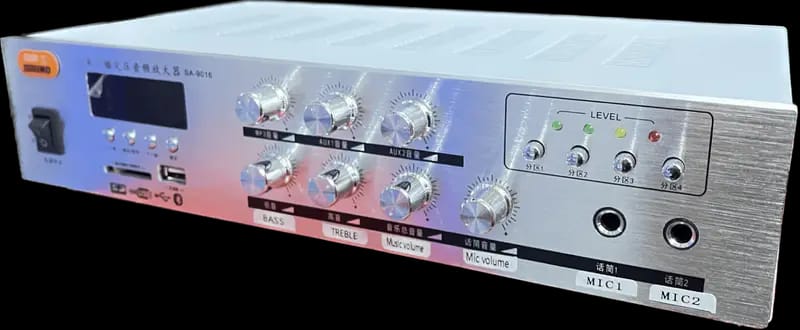
Indoor Power Amplifier
Indoor Power amplifier is the “heavy lifter” of the electronics world. While a standard voltage amplifier (like a preamp) focuses on making a weak signal “taller” (increasing voltage), a power amplifier focuses on making that signal stronger (increasing current) so it can actually do work—like moving a heavy speaker cone or sending a radio signal miles into the atmosphere. Think of it like this: a voltage amplifier is the driver giving directions, and the power amplifier is the engine actually turning the wheels. 1. How It Works A power amplifier doesn’t actually “create” power; it acts as a converter. It takes DC energy from a power supply and, guided by a small input signal, converts that energy into a high-power AC output. Key Components Transistors (BJT or MOSFET): The “valves” that control the flow of current. Heat Sinks: Because power amplifiers handle high current, they generate significant heat and require metal fins or fans for cooling. Power Supply: Often a large transformer or switching supply that provides the “raw” energy to be converted. 2. The “Classes” of Amplifiers Amplifiers are categorized by how long their transistors stay “on” during a signal cycle (conduction angle). This determines their efficiency versus their fidelity. 1 Class How it works Efficiency Best Feature Class A Transistor is “on” 100% of the time. ~25% (Very Low) Highest sound quality/No distortion. Class B Two transistors; each is “on” for 50% of the cycle. ~78% (High) Efficient, but has “crossover distortion.” Class AB A hybrid; both transistors stay slightly on at the center. 50–60% Best balance for Hi-Fi audio. Class D “Switching” amp; pulses on/off very fast (PWM). >90% (Elite) Tiny size, stays cool (phones, pro audio). Class C Conduction for <50% of the cycle. ~80% Only for RF/Radio (too distorted for music). 3. Power vs. Voltage Amplifiers It’s easy to confuse the two, but they serve different roles in a signal chain: Voltage Amplifier (Small Signal): Usually the first stage. It boosts a few millivolts (from a microphone or guitar) to a few volts. It uses tiny transistors and produces almost no heat. Power Amplifier (Large Signal): Usually the final stage. It takes those few volts and provides the massive current needed to drive a low-impedance load (like a 4Ω or 8Ω speaker). 1 4. Common Applications Audio: Driving home theater speakers, concert PA systems, or headphones. RF (Radio Frequency): Boosting signals in cell towers, TV transmitters, and Wi-Fi routers. Industrial: Controlling high-torque motors or actuators in robotics.
$ 95.77